
What is Strategic Questioning?
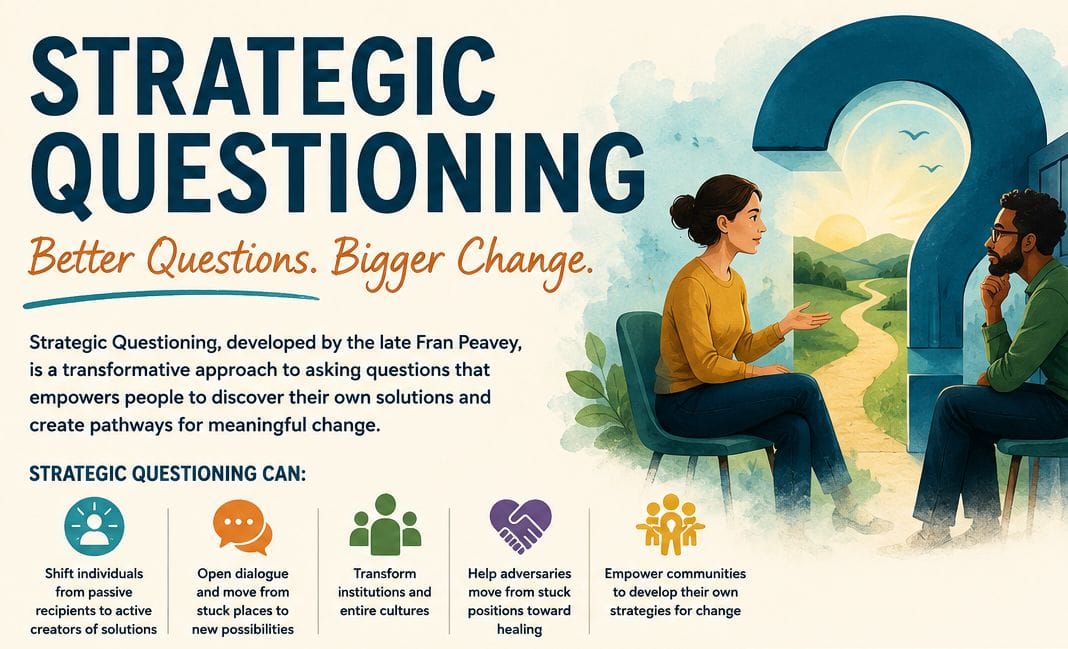
Strategic Questioning is a communication and facilitation method developed by the late Fran Peavey for catalyzing personal and social change. It is a transformative approach to asking questions that empowers people to move from passive observation to active problem-solving. Rather than simply gathering information, strategic questions help individuals and groups discover their own solutions and create pathways for meaningful change.
Strategic questioning can:
- Shift individuals from passive recipients to active creators of solutions
- Open the dialogue up — moving from stuck places or polarized positions toward new possibilities
- Transform institutions and entire cultures
- Help adversaries move from stuck positions toward healing and reconciliation
- Empower communities to develop their own strategies for change
When we ask strategic questions and truly listen to the answers, we don’t just help others—we open ourselves to transformation as well. This is perhaps the greatest service anyone working for social or personal change can offer: helping people discover the solutions that already exist within them.
The Problem with Traditional Questioning
Most of us were raised in educational systems that taught us to ask questions with predetermined “correct” answers. We learned that:
- Questions have single, finite answers
- Wrong answers deserve punishment
- Asking questions that challenge authority is uncomfortable or inappropriate
- Not knowing the answer is something to hide
This conditioning leaves us ill-equipped for the complex, uncertain questions we face in real life—questions without simple answers that require creative exploration and fresh thinking.
“Long-Lever Questions” vs “Short-Lever Questions”
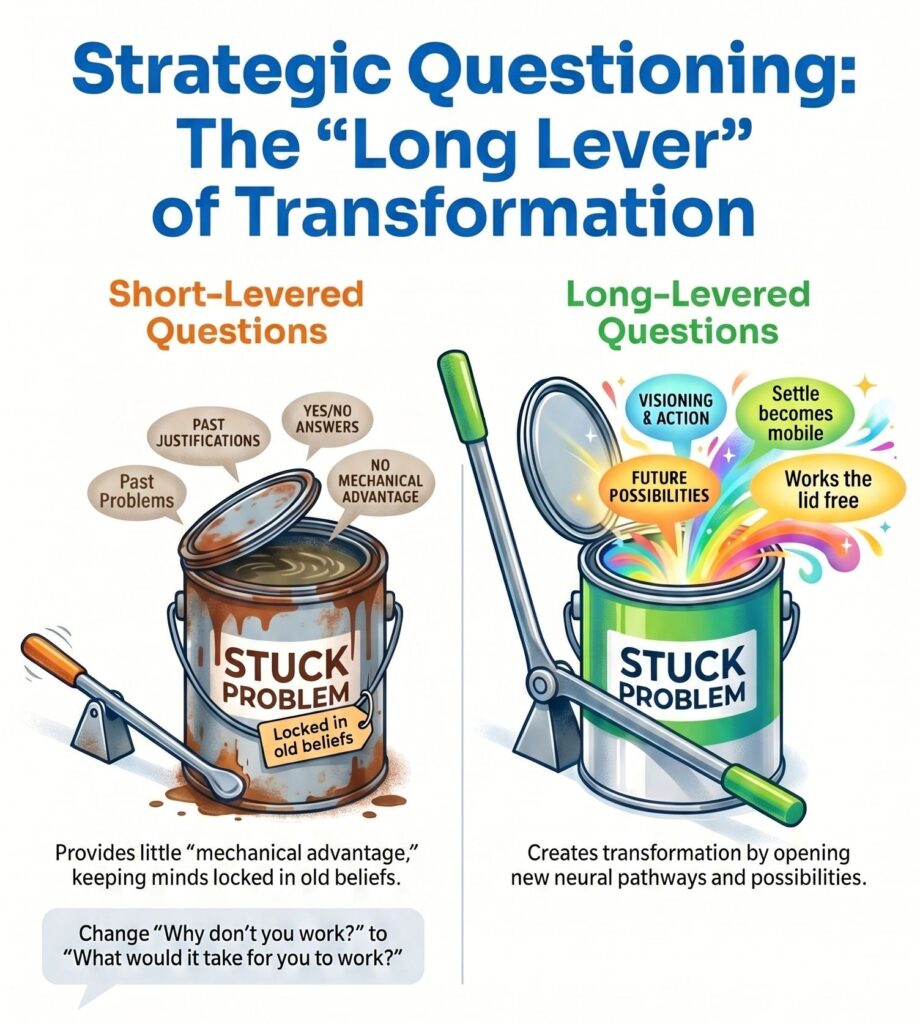
Central to Peavey’s approach is the distinction between short-lever questions and long-lever questions. She suggested that a question can work like a lever used to pry the stuck lid off a paint can. With a short lever you crack the lid — a sliver of air, nothing really stirred. With a longer one you work the lid free, and what had been sealed and settled can move again.
Some people meet a problem the way you’d meet a closed paint can: the contents are in there, but crusted shut. A question with enough leverage, digging deep enough, reaches the creative solutions that were already inside.
Short-Levered Questions
A short levered question has limited mechanical advantage—it doesn’t move much or create change. It doesn’t open minds to new perspectives, it keeps them locked in old bel
iefs and ways of being. However, it’s helpful to begin a questioning process with “lower-lever” questions (Focus, Observation, Analysis, Feelings) to build shared understanding and safe space. “Why” questions and “Yes/No” questions tend to fall into this category because they focus on defending past decisions or rationalizing the present.
Long-Levered Questions
A long-levered questions has greater mechanical advantage—they create the most change, new perspectives and transformation with the least resistance. You can tell when you’ve asked a long-lever question: the person you are speaking to often stops and does a double-take and says something like, “I hadn’t thought of that before.” You can almost feel new neural pathways opening in their brain as they slowly respond.
Then moves to “higher-lever” strategic questions to open up possibilities
These are questions that:
- Open up multiple options and are focused on Visioning, Change, Alternatives, Consequences, Actions
- Create forward motion through the very asking of the question.
- Focus on future possibilities rather than past justifications
- Empower people to discover their own solutions
- Challenge underlying values and assumptions
When she spoke about this, Peavey would say
So while “Why don’t you work on poverty?” is a short lever question, something like “What would it take for you to work on poverty?” or “What draws you toward working on poverty?” would be more long-levered—generating more movement, options, and creative thinking.
 The Seven Key Features of Strategic Questions
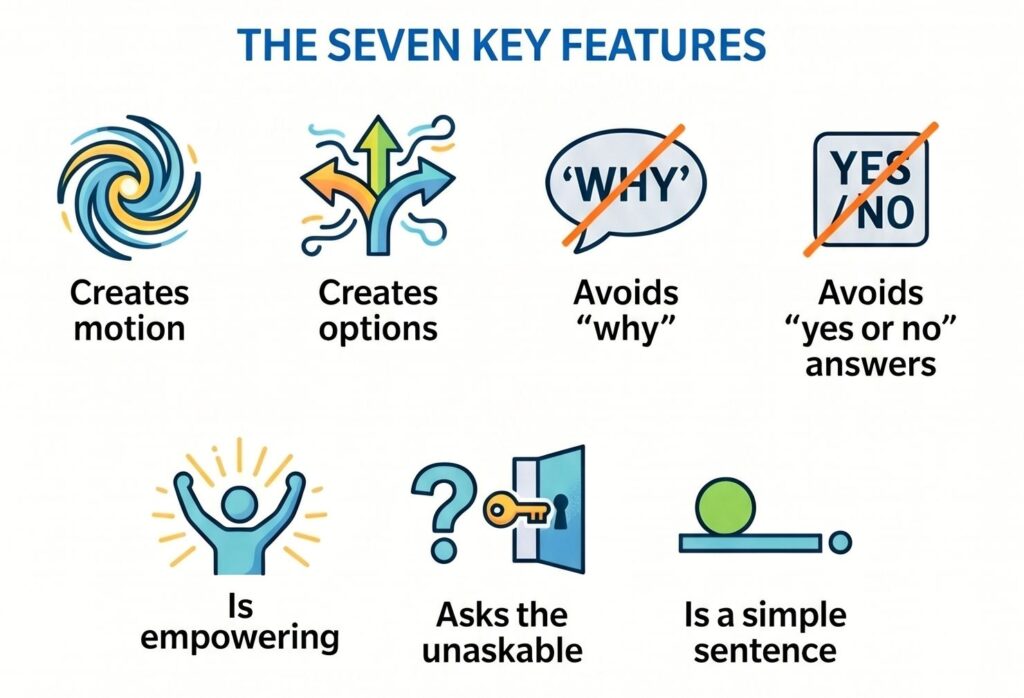
Peavey divides questions into “families” or levels. These go from more descriptive, observational, and feeling-oriented questions (which help frame or understand a situation) toward more strategic, change-oriented questions (which open up vision, alternatives, obstacles, actions). Here are the qualities of a change-oriented strategic question:
1. Creates Motion
Strategic questions generate movement rather than keeping situations stuck. Instead of asking “Why don’t you move to Sydney?” (which is really a disguised suggestion), ask “What type of place would you like to move to?” This approach works with a person’s energy rather than against it, similar to the principles of Tai Chi.
2. Creates Options
Effective strategic questions open up multiple possibilities rather than narrowing focus to one or two choices. Instead of binary thinking (this or that), they encourage exploration of many alternatives. For example, “What are three or four places you feel connected to?” invites broader thinking than suggesting a single location.
3. Avoids “Why”
“Why” questions tend to force people to defend past decisions or rationalize the present, often creating resistance to change. Compare “Why don’t you work on poverty?” with “What keeps you from working on poverty?” The latter creates more openness to exploration.
4. Avoids “Yes or No” Answers
Questions requiring only yes/no responses leave people in passive, uncreative states. Rephrasing to open-ended questions dramatically improves dialogue and engagement.
5. Is Empowering
Strategic questions assume the person being asked has valuable contributions to make. “What would it take for you to change on this issue?” invites someone to co-create solutions rather than having ideas imposed upon them. This is the opposite of manipulation—it draws out what’s already in someone’s mind and helps develop it further.
6. Asks the Unaskable
Every individual, group, and society has taboo questions—and these often hold tremendous power. Strategic questioning dares to challenge the underlying values and assumptions that keep issues stuck. Like the child who asked why the emperor had no clothes, these questions can catalyze revolution and transformation.
7. Is a Simple Sentence
The question should enter the mind cleanly, like a diver slipping into water. Complex, multi-part questions should be broken into separate, clear inquiries.
Checking Your Assumptions
Strategic questioning requires approaching people with an assumption of health—believing they want positive change even when they appear apathetic. What looks like apathy is often fear of caring too much or anger at feeling helpless. The questioner must trust that people possess the answers needed and are more powerful than they (or we) may realize.
 About Fran Peavey and the Origins of Strategic Questioning
-
Peavey began developing the approach in the 1980s and 1990s within contexts of activism, organizing, social change work.
-
She found that in social change settings, simply providing information or advice often fails to shift power, values, or sustained action. What tends to work more deeply is helping people articulate their own understandings, values, hopes, obstacles. Strategic questioning grew out of that insight.
-
The method was refined via workshops, collaborative editing (for example with Vivian Hutchinson), in activism networks (e.g. Interhelp), and via applications in community organizing, campaign strategy, group consultations, one-on-one dialogues.
- In her live workshops she would return, again and again, to listening. A strategic question is only half the work; the other half is the quality of attention that receives the answer. Peavey described the listening as the kind we do when we sense ourselves in danger — alone in the house at night, a noise downstairs, every sense suddenly awake. Ordinary conversation asks far less of us. When we do listen that closely, people begin to say things that surprise them — putting ideas together with a clarity and coherence they did not know they possessed.
- Peavey was also honest that no question is guaranteed to be strategic; it depends on the moment, the relationship, the person. And a genuinely strategic question may not be answered in the room at all. It can keep working in the mind for days or weeks — the seed gets planted, and the answer grows in its own time. That is the quiet wager underneath the whole method: the people in front of us already carry what they need, and a question asked well enough can help them reach it