
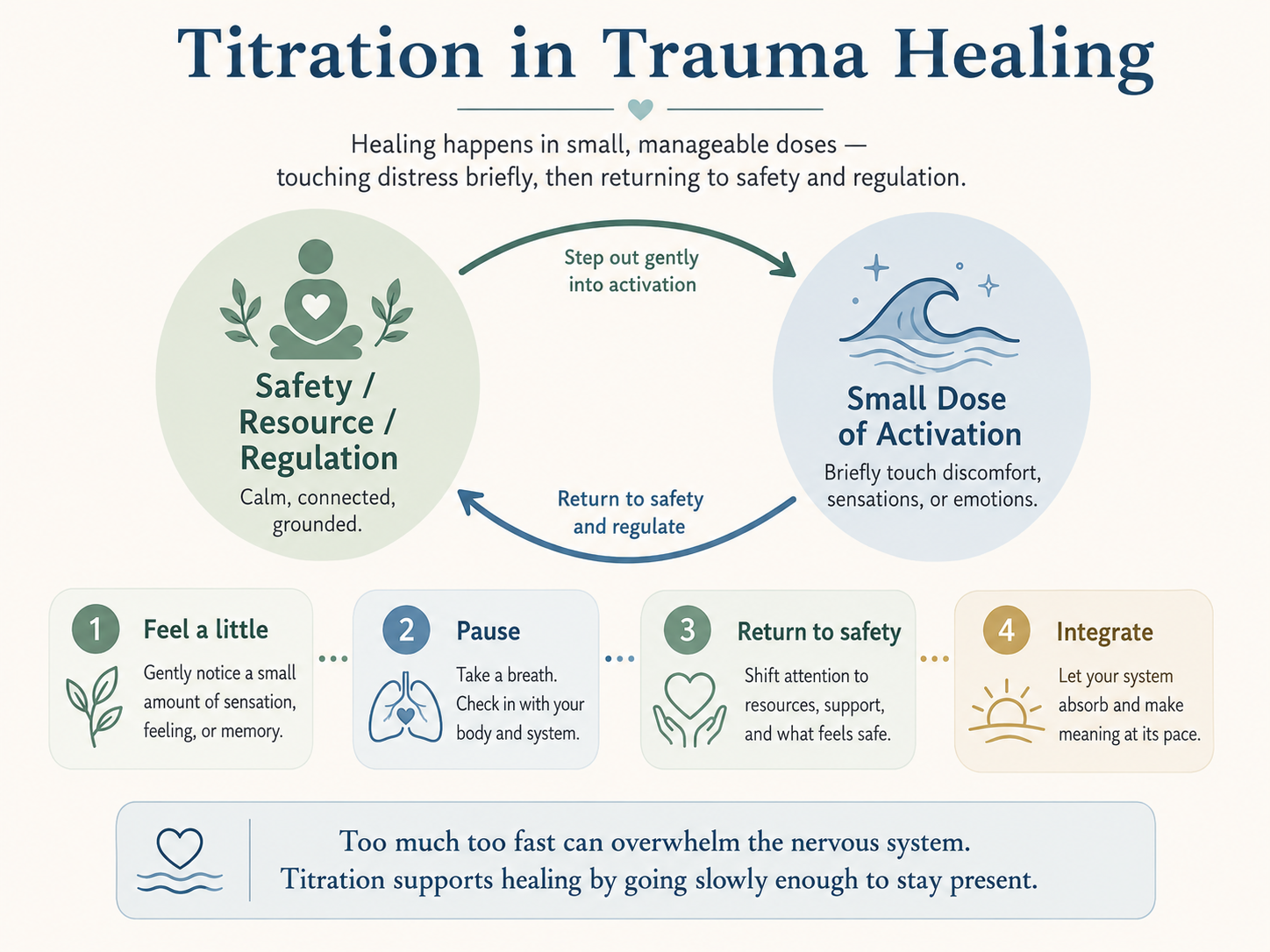
When you are healing from trauma, there is a very important skill to have in your toolbox — one that may determine whether the work opens something or overwhelms you. It is called titration, and it is very important to understand in the healing journey.
The body knows something that well-meaning helpers sometimes forget: more is not always better, and faster is rarely the point. What the system needs in those moments is not a push through but a different relationship to pacing. That is where titration comes in.
A Little Bit, Slowly
The word comes from chemistry — the slow, measured addition of one substance to another, drop by drop, until a precise result is achieved. In trauma work, the principle is similar: approaching difficult material in small, deliberate doses rather than all at once.
Titration may be the deliberate reversal of what trauma does. Trauma, at its core, is too much too fast — an experience that arrives before the system has the capacity to metabolize it. Titration does the exact opposite. A little bit, slowly. The nervous system gets to say: I have time. I can handle this portion. I am not being flooded.
Somatic practitioner Jill Satterfield describes it as moving both toward and away from difficult material — not denial, not avoidance, but a kind of rhythmic approach that keeps body and mind in a workable relationship with what is arising. Touch it briefly. Return to something stable. Touch it again.
The Window This Opens
Dan Siegel’s concept of the window of tolerance offers useful framing here. The window is the zone in which a person can feel something difficult — grief, fear, shame, anger — while remaining integrated enough to think, choose, and stay present. Inside the window, emotion and cognition can work together. Outside it, the system moves toward chaos (flooding, overwhelm, fragmentation) or rigidity (shutdown, dissociation, numbness).
Trauma tends to narrow that window for specific triggers or material. A person who has experienced significant wounding may find the window narrowing quickly, reaching the edge with less provocation than they might expect of themselves. In Siegel’s model, this is not weakness — it is impaired integration, a sign that the system was asked to carry more than it could metabolize at the time.
Titration works by keeping experience inside that window. Rather than charging directly at the material, you approach the edge, feel what is there, and return to something stable — a breath, a sensation, the light in the room, the feeling of feet on the floor. Then you approach again. Each approach and return builds what might be called tolerance, though I prefer to think of it as capacity — the gradual widening of what the system can be with.
Practicing It
This does not require a formal session to begin exploring. In any moment that feels like too much, the practice is simply: touch it briefly, then return.
Return to what? To something in the present that is manageable — a sound, a physical sensation, a visual anchor. The breath, when it is steady. The texture of a surface. The quality of light.
One image has stayed with me from the somatic literature: titration tells the innermost, most defended places in us — you no longer have to come out all at once. I am slowing down enough now to let you emerge one piece at a time.
That shift in relationship — from urgency to patience, from forcing to allowing — is one of the more underrated elements in healing work.
Finding the Balance
There is a persistent idea in some spiritual and mindfulness circles that the right move is always to go directly into pain — to face it head-on, stay with it, push through. There is something true in that impulse. Avoidance does not serve healing.
And it’s also important to realize: walking straight into a fire is not always wisdom. The system that shuts down under direct confrontation is not failing. It is protecting itself the only way it knows how.
The question worth sitting with may not be how do I face this but something more like: at what pace, in what dose, with what kind of support, can I be with this without being destroyed by it?
That question opens a different kind of door — one that healing can actually walk through.