
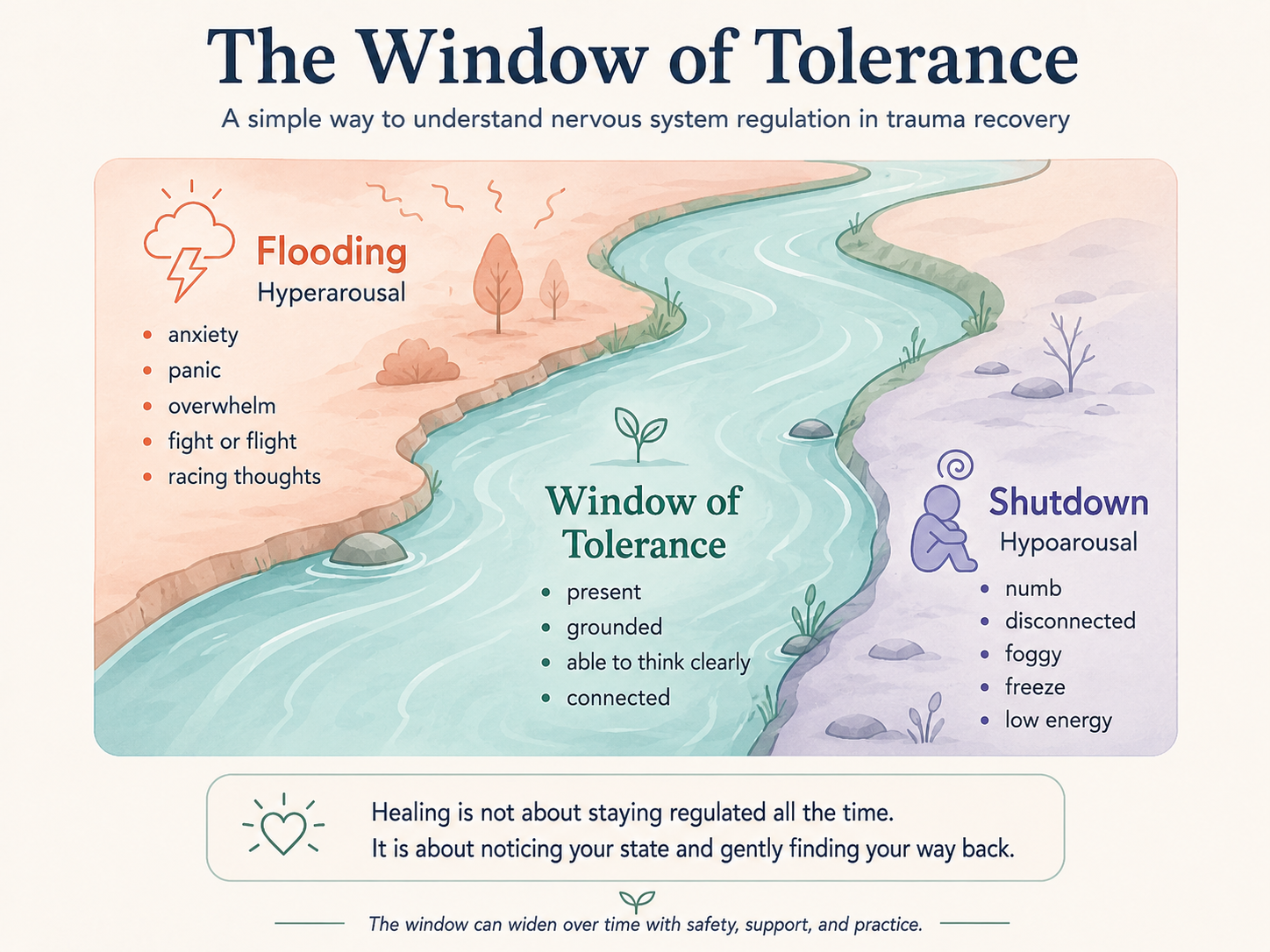
Dan Siegel used the metaphor of a river to describe what healing from trauma actually looks like — a slow, nonlinear process of learning to stay in the current, finding the channel where the water moves freely. Most of us have a bank we default to under pressure, a way the nervous system learned to keep us functional when functional was the best it could manage.
The River and Its Banks
Picture a river moving through open country with current and depth and occasional eddies that pull at you sideways. In the middle, the water moves freely. Too far left and you hit the left bank and you ground into chaos, and may start spinning. Too far right and you lodge into the right bank, and experience rigidity and stuckness. The river keeps moving when you stay near the center.
That is the whole metaphor, and it is more precise than it looks.
Dan Siegel spent years in conversation with physicists and mathematicians working on a specific question: how does a complex system self-organize optimally? The answer, drawn from systems theory, is that optimal self-organization produces a cluster of qualities Siegel abbreviates as FACES — flexible, adaptive, coherent, energized, stable. That cluster is what health feels like from the inside: moving, responsive, able to hold what arises without collapsing under it.
What the Banks Actually Are
Chaos is one bank — the system has lost regulatory coherence. It can’t contain itself. Experiences flood in without context, without edges. Intrusive memories arrive as present-tense events rather than as remembering, and this is not metaphor: the amygdala carries no timestamp. Traumatic material encoded without full hippocampal involvement — which happens because cortisol suppresses hippocampal function under acute stress — arrives with no marker that says this was then. The alarm keeps sounding in the present.
The body keeps responding to what the mind knows is over.
Rigidity is the other bank. The system has over-constrained itself. It sacrificed aliveness for control, and the cost is a certain flatness — a body managed rather than inhabited, a relationship to emotion conducted mostly from the analytical distance. John Welwood named this the “upper-story retreat”: the preference for meaning-making, analysis, or spiritual interpretation over the felt vulnerability underneath. It is a strategy that worked. The system learned that constriction is survivable and activation is dangerous. That learning doesn’t disappear just because the original danger has.
What Siegel noticed is that every psychiatric diagnosis maps onto one bank or the other — or onto the oscillation between both. PTSD is a particularly transparent case: flashbacks and intrusion on one side, avoidance and numbing on the other, many people living in both simultaneously, sometimes within the same hour.
What Widens the Channel
The word Siegel uses is mindsight — the capacity to perceive one’s own mental life with intimacy rather than fusion. Not analysis. Not detachment. Intimate familiarity without being identical with what’s being observed. Grief can be felt deeply while also being known as grief. That dual quality — one foot in the experience, one foot witnessing — is what makes metabolizing material possible, rather than simply re-living it.
Narrative does real neurological work here. Constructing a coherent story of what happened requires the simultaneous activation of systems that trauma holds apart: left-hemisphere sequence and language, right-hemisphere imagery and body sensation, prefrontal self-reflection, limbic charge. The act of storying is itself integrative. The hippocampus gets engaged and places implicit material in time — located in the past rather than perpetually arriving as now.
What all of these paths share: each one widens the channel by increasing the system’s capacity to stay present to experience without being swept to either bank. The window expands not because the material becomes less intense, but because the nervous system has developed more room to hold what’s arising. Siegel suggests that this is slow work. The channel widens over time.
So take heart, and keep building your skills at navigating that river current!